
Afrobarometer strengthens data literacy for journalists, civil society, and scholars from lusophone Africa


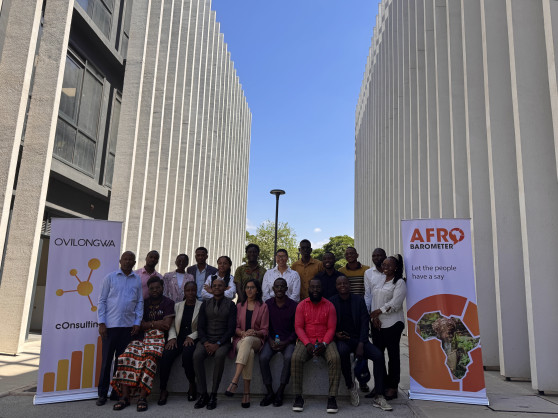
Afrobarometer (www.Afrobarometer.org) has completed two weeks of training for journalists, civil society actors, and students and faculty from universities in Luanda and Huambo as part of its inaugural data-analysis workshops for participants from the lusophone African region.
The series of workshops provided a rare opportunity for participants from Angola, Cabo Verde, Guinea-Bissau, and Mozambique – many of whom had never previously attended Afrobarometer trainings – to build foundational skills in accessing, analysing, and interpreting Afrobarometer survey data. Participants strengthened their ability to use data effectively for news reporting, policy advocacy, and learning and teaching.
“Participants walk away from the training with improved capacity to transform public-opinion data into compelling, evidence-based stories, policy advocacy, and research outputs that elevate citizen voices and strengthen public discourse across Angola and the lusophone region,” said Dominique Dryding, Afrobarometer’s capacity building manager (basic track).
Avelino Domingos, journalist for Rádio Essencial in Angola, highlighted the value of the training for distilling data-driven narratives grounded in citizen experiences and evaluations.
“I’m excited to apply the knowledge I’ve gained over the last three days in my investigations into the realities of everyday Angolans,” he said. “I also look forward to helping citizens understand the work of Afrobarometer in Africa, and particularly in Angola.”
Participants also lauded the user-friendly nature of the online data analysis (ODA) tool.
“The most exceptional thing about the Afrobarometer data is that you don’t need to be an expert to use it,” said Cláudia Fernandes de Brito, a communications specialist from Cabo Verde. “It’s in the public domain and freely available on the Afrobarometer website. All you have to do is access the data through the ODA and just use it.”
The workshops form part of Afrobarometer’s broader commitment to spreading data literacy and bolstering evidence-based decision making across all corners of Africa. By expanding the pool of practitioners who can responsibly use public-attitude data, Afrobarometer aims to amplify citizen voices for democratic governance, inform reporting and advocacy, deepen stakeholder engagement, and reinforce the organisation’s role as a key continental resource for research and capacity building.
Distributed by APO Group on behalf of Afrobarometer.
For more information, please contact:
Asafika Mpako
Communications coordinator for Southern Africa
Telephone: +27 83 979 8299
Email: ampako@afrobarometer.org
Social Media:
Facebook
X
LinkedIn
YouTube
Instagram
WhatsApp
Bluesky
Follow our releases on #VoicesAfrica.
About Afrobarometer:
Afrobarometer (AB) is a trusted source of high-quality data and analysis on what Africans are thinking. With an unmatched track record of 430,000+ interviews in 45 countries, representing the views of more than 75% of the African population, AB is leading the charge to bridge the continent’s data gap. AB data inform many global indices, such as the Ibrahim Index of African Governance, Transparency International’s Global Corruption Barometer, and the World Bank’s Worldwide Governance Indicators. The data are also used for country risk analyses and by credit rating and forecasting agencies such as the Economist Intelligence Unit. All AB data sets are publicly available on the website (www.Afrobarometer.org) and may be analysed free of charge using AB’s online data analysis tool (http://apo-opa.co/3KVYHTl).
Visit us online at: www.Afrobarometer.org
About Ovilongwa Consulting:
Ovilongwa Consulting is Afrobarometer’s national partner in Angola. Created in 2019 by Angolans David Boio and Carlos Pacatolo, the company intends to fulfil the meaning of the expression “ovilongwa,” which means to deepen and share knowledge. That is, to know what Angolans from Cabinda to Cunene say about how they live and what they think, to transform that “voice” into knowledge through scientific and statistical analysis, and to share it with political actors, civil society, and citizens.
Visit us online at: www.Ovilongwa.org
