

Strengthening Louisiana-Africa relations: LGLE opens new path for trade and investment

By Ndubuisi Micheal Obineme
Louisiana is paving the way for stronger trade and investment ties with African counterparts through the Louisiana Global Leadership Exchange (LGLE), a new international initiative designed to transform the state’s deep cultural connections with Africa into concrete opportunities for trade, investment, education, and economic development.
The inaugural LGLE event, held on 23-24 October 2026 in Paris, brought together Louisiana elected officials, companies, businesses and industry leaders, universities, economic development organizations, diplomats, and government representatives for a focused program built around direct connections and potential partnerships.
In her opening remarks, Hon. Lady Fontenette Brown, founder of the Louisiana Global Leadership Exchange and its Chief Cultural Ambassador, highlighted the deep cultural ties between Louisiana and Africa. She emphasized the premise of the Exchange: culture creates connection, connection builds trust, and trust opens the pathway to commerce. That approach positions Louisiana as a global gateway of opportunity for Africa, and Africa as a gateway of opportunity for Louisiana.
“Geographically, Africa and Louisiana may seem far apart, but history, heritage, and shared experiences tell us a different story. We do not have to invent a relationship with Africa; we inherited one. Our opportunity is to build on that cultural inheritance through trade, investment, education, tourism, innovation, and lasting partnership.”
Ryan K. Haynie, the Exchange’s Chief Business Ambassador, helped connect Louisiana business leaders with African investors and institutions. His role focused on moving relationships beyond introductions toward specific trade, investment, and commercial opportunities.
The Honorable Helena Moreno, Mayor of New Orleans, was represented at the Louisiana Global Leadership Exchange in Paris by Dr. Jenny Mains, Special Advisor to the Mayor for International Partnerships and Strategic Economic Development, who accepted the city’s recognition as the 2026 LGLE Louisiana City of Cultural Distinction.
Speaking on behalf of the New Orleans Mayor, Dr. Mains said, “Our connection to Africa is part of our history, and there’s so much more we can build together through business, education, cultural exchange, and opportunities for our young people. New Orleans is open for business.”
In a video address, Congressman Troy Carter of Louisiana said the LGLE aims to shape the future of business between Louisiana and Africa in major industries: energy, education, tourism, and technology.
He highlighted Louisiana’s central role in waterborne commerce and energy trade, including significant exports of energy and LNG.
In addition, he said commodities from African markets, such as cocoa, cashews, and coffee, present opportunities for candy manufacturers, specialty grocery stores, and local entrepreneurs in Louisiana to establish thriving businesses.
“We have a unique opportunity to expand and enhance the bridges between Louisiana, Africa, and the world in its energy, maritime infrastructure, agriculture, and trade.”
“This exchange showcases what Louisiana, Africa, and the African diaspora share, ensuring we create new opportunities and build better economies, advance energy, and agriculture.”
Louisiana has announced nearly $260 billion in capital investment projects since 2024, according to Louisiana Economic Development. This economic momentum builds on the state’s traditional industrial strengths while opening opportunities in technology, aerospace, and advanced energy.
“We’re not going to pull that off alone. We’re going to need people, resources, expanding energy, manufacturing, technology, and other industries,” Jeremy P. Stine, Louisiana State Senator and Honourable Chief Francophonie Ambassador, said during his remarks.
Senator Stine stated that Louisiana’s resources, the Mississippi River, and its ports connect the state to global markets, creating opportunities for Louisiana companies and partners.
On energy, Senator Stine added that Louisiana accounts for more than 60% of the country’s LNG exports, placing the state at the center of global energy trade.
State Representative Troy Jude Hebert of Louisiana’s District 31 addressed the state’s economic opportunities and cultural strengths. He pointed to the potential for Louisiana’s industries, entrepreneurs, and cultural connections to support practical partnerships with African counterparts.
At the Seeds of Partnership: Agriculture session, Jesica Kincaid of USA Rice discussed agricultural trade and partnership opportunities between Louisiana and African markets.
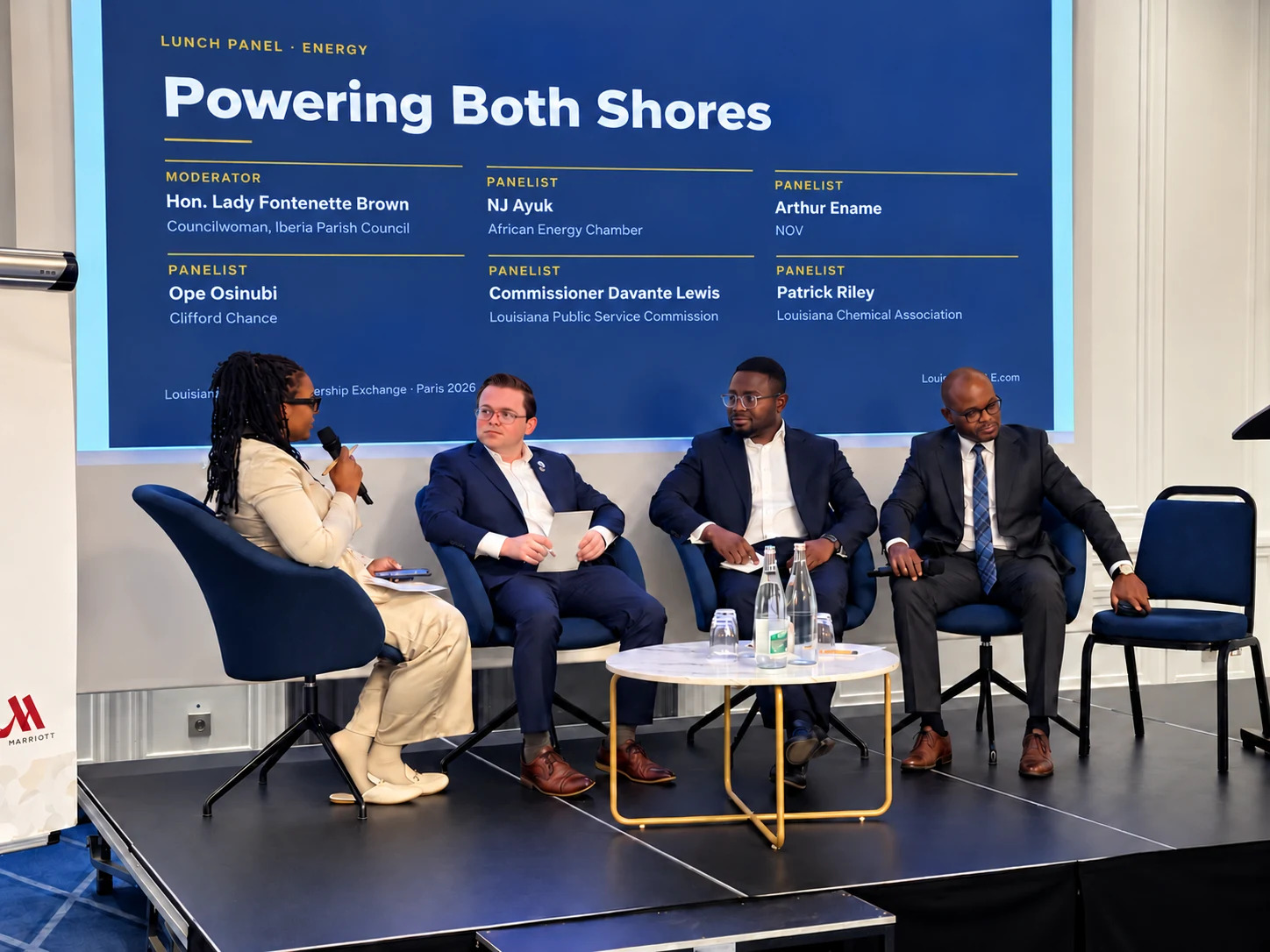
During the Powering Both Shores: Energy panel, Patrick Riley, Director of Governmental Affairs and Assistant General Counsel at the Louisiana Chemistry Association, emphasized the breadth of Louisiana’s energy and chemical industries. He described an industrial base spanning upstream, midstream, and downstream activities, supported by a strong chemical sector.
Riley also pointed to Louisiana’s shipping hub and deepwater ports as important assets for developing partnerships with African counterparts in the energy, oil, and gas sectors.
“Louisiana has a large industrial base including upstream, midstream, downstream and a vibrant chemical industry.”
“We have a massive shipping hub and access to deepwater ports. There are opportunities to partner with Africa in the energy, oil and gas sector,” he added.
The Powering Both Shores: Energy discussion also featured Ope Osinubi, a Senior Associate in Clifford Chance’s Energy & Infrastructure Group, and Arthur Ename, Vice President for Africa at NOV.
The panel explored opportunities for cooperation in energy development, infrastructure, project finance, and industry relationships between Louisiana and Africa.
Harrison Crabtree, Executive Director, World Trade Center New Orleans, highlighted the competitive advantages that make Louisiana a leading gateway for global commerce and a potential bridge to African markets.
Crabtree said Louisiana’s port network provides access to inland markets through the Mississippi River and its connected waterways. The Port of New Orleans is also served by all six Class I railroads.
Crabtree also highlighted Louisiana Global Connect, established in strategic partnership with Louisiana Economic Development. The initiative is the state’s unified vehicle for proactive, focused international business recruitment. It takes a coordinated, whole-government approach, using international representatives in key markets and trade initiatives like today’s event to give foreign investors a true concierge service.
“Louisiana is open, organized, and committed to being a business hub,” Crabtree stated.
He pointed to opportunities in critical minerals, agricultural exports, and maritime trade, with Louisiana well positioned to deepen commercial ties with African markets through its logistics infrastructure.
“By connecting African markets directly with our people, our ports and industrial strength, we can build a forward-looking trade network that benefits businesses on both sides of the Atlantic,” Crabtree said.
“Together, let us continue to grow our economies and share in economic prosperity.”
On the Culture Is Global Currency: The Creative Economy panel, Scott Feehan of Festival International de Louisiane and Peggy Feehan of CODOFIL joined the discussion of how Louisiana’s festivals, Francophone heritage, and creative industries can strengthen cultural and commercial ties with African counterparts.
Chanell Andrews, representing the Diaspora African Forum (DAF), addressed the Sixth Region, a term for the African diaspora, and the importance of sustained relationships between diaspora communities and the African continent.
The LGLE also hosted a panel session, with a diverse group of institutional investors, private equity representatives, and trade-finance and public-sector leaders.
The session highlighted Louisiana’s economic growth, as the state’s gross domestic product reached more than $340 billion in 2025, according to Bureau of Economic Analysis figures. The figure underscores opportunities for collaboration across the state’s vital industries.
Louisiana exported about $655 million in goods to sub-Saharan Africa in 2025, providing a foundation for greater two-way engagement in agriculture, energy, and other sectors.
Speaking at the panel session, Tamara Maxwell, Acting Senior Vice President at the Export-Import Bank of the United States (EXIM), outlined financing tools that can support Louisiana exporters and African buyers.
She explained that EXIM helps finance eligible exports of goods and services, benefiting businesses and the foreign buyers who purchase from them.
She mentioned that companies with a contract or purchase order may be eligible for financing to manufacture or acquire the goods they are selling.
Additionally, she pointed out that African buyers may be able to secure financing for eligible equipment and machinery, with transactions facilitated through participating lenders.
The African Energy Chamber is a Founding Partner of the Louisiana Global Leadership Exchange. The partnership reflects a deliberate effort to develop lasting relationships between Louisiana and African business and energy leaders. Plans are being developed for a Louisiana delegation to participate in future Chamber programming, including opportunities connected to African Energy Week, the Chamber’s annual international gathering.
In her closing remarks at the Exchange, Louisiana Senate President Pro Tempore Regina Ashford Barrow emphasized that trust, consistency, and mutual respect are essential to building lasting relationships.
She urged participants to carry the dialogue beyond Paris and strengthen connections between Louisiana and African leaders, businesses, and institutions.
The 2026 inaugural Exchange marks the beginning of a longer-term initiative. The Louisiana Global Leadership Exchange is the anchor international event for the Louisiana Africa Council, providing a platform for sustained relationships and opportunities between Louisiana and Africa. Organizers plan to bring future editions of the Exchange to the African continent, building on the relationships established in Paris.

