
Ch0C gas boiler to help French industry decarbonize – Jean-Marc, NaTran

To limit global warming to 1.5°C, France has set an ambitious target to reduce its greenhouse gas emissions by 50% by 2030 and achieve carbon neutrality by 2050, part of the country’s long-term strategy to decarbonize the energy sector.
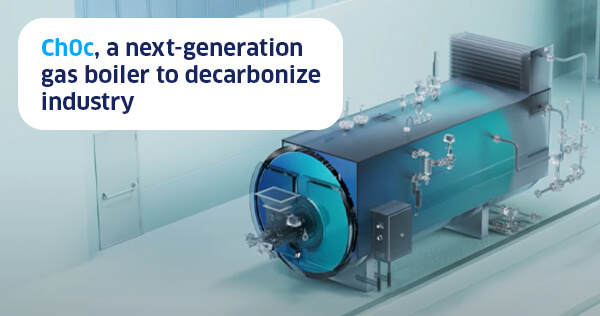
As part of efforts to decarbonize the French energy sector, a consortium of 16 French companies has developed a new boiler known as Ch0C gas low-carbon boiler. The consortium, led by Naldeo Technologies & Industries, brings together energy companies, equipment manufacturers, scientific experts, and industrialists. Babcock Wanson, ENGIE Solutions, Fives, GRDF, NaTran, TotalEnergies, and Verdemobil Biogaz are partner members of the project. Agrial, Agro Mousquetaires, Bonduelle, Carboneo, Coca-Cola, Constellium, Eiffage Énergie Systèmes, and the University of Paris are observer members.
Industrial boilers represent 23% of the overall emissions of French industry, according to a report. However, the Ch0C gas boiler is developed with cutting-edge technologies, making it possible to achieve a very high level of decarbonization at a competitive cost. The boiler has been commissioned at the Villers-Saint-Paul site (Oise).
In this interview, Jean-Marc LE GALL, Director of the Renewable Gas Development Division, NaTran, talks to Ndubuisi Micheal Obineme, Managing Editor, The Energy Republic, about the Ch0C gas boiler’s competitive advantages and its technological advancement for decarbonization of the French energy sector. Excerpts:
TER: Please tell us about the Ch0C gas boiler.
Jean-Marc: We developed the boiler with a consortium of industry players. The purpose of the boiler is to help the French industry decarbonize. Instead of burning the gas into the air, we burn it with oxygen. It captures the carbon dioxide in the facility, which can be reused.
We have been working with the consortium and demonstrating the facility in Paris. We will open the facility to allow industry players to visit our Ch0C gas boiler facility by September 2026.
TER: What are the specifications of the Choc boiler?
Jean-Marc: Technically, the range of power that can be generated with this kind of boiler starts from 3MW to 30MW. It corresponds to a diversity of industrial uses, and the carbon dioxide is liquified, enabling it to be transported easily, and making it an easy way for carbon dioxide logistics.
The facility has no smoke.
TER: Which specific technologies are integrated into the Choc boiler?
Jean-Marc: The main feature that differentiates the Choc boiler from other boilers is that it uses oxygen as an input. We call it Oxycombustion in French.
TER: How will the boiler impact the French energy sector, particularly on greenhouse gas emissions?
Jean-Marc: Basically, when you use such a facility, you divide your emissions by 10. It’s quite significant.
At a wider scale, it captures millions of tons of carbon dioxide to be stored in the facility.
We are currently in the demonstration stage. But we see the great potential of the Choc boiler.
TER: What are the competitive advantages of the boiler in terms of cost and benefits to end users?
Jean-Marc: We did a comprehensive study on the Choc gas boiler, comparing it with other decarbonization solutions, such as biomass that can be used in boilers.
In terms of cost, the Choc boiler is comparable to what you get from other decarbonization solutions. It is competitive.
TER: Who is your target market? Is it only French consumers? Or the European and global market?
Jean-Marc: We are open to any interest from anywhere.
TER: How does the boiler align with sustainability?
Jean-Marc: The whole idea of this boiler is to be sustainable.
TER: What is your outlook for the French energy sector?
Jean-Marc: My outlook for the French energy sector is that decarbonization is underway.
Renewable gases represent a low proportion of the total gas consumed in France. But it is constantly growing, and the potential is there.
We have seen a new range of projects that enable the production of renewable gases.
We are optimistic that the carbon neutrality target by 2050 is a credible target.
TER: Are there other projects NaTran is involved in that you would like to share with us?
Jean-Marc: The Choc boiler is our main project for gas use.
We have numerous projects related to gas and renewable gas production.
NaTran is on both sides of the energy value chain.