

Nigeria Ends OPL245 Dispute After 15 Years, Unlocks Major Deepwater Investment

By Ndubuisi Micheal Obineme
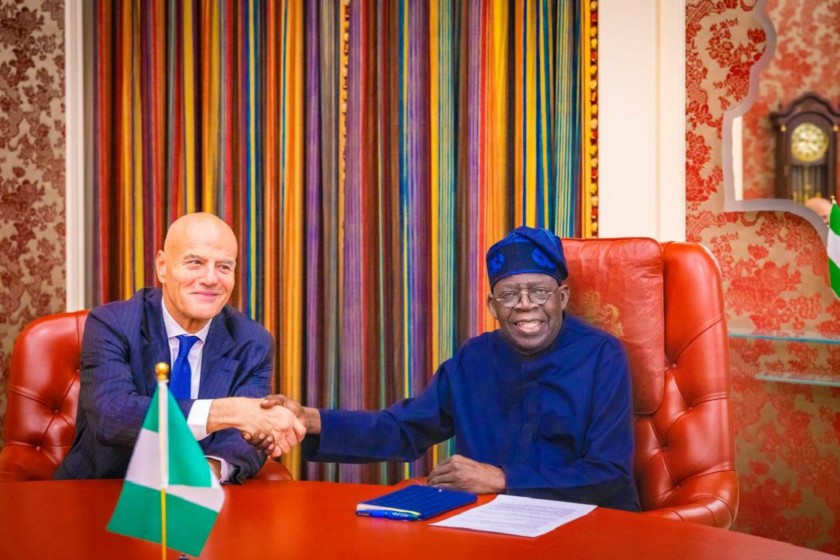
President Bola Tinubu has presided over the successful conclusion of a historic settlement agreement between the Federal Government of Nigeria, ENI, and Nigerian Agip Exploration Limited (NAEL), resolving the long-running dispute about Oil Prospecting Licence (OPL) 245.
The settlement meeting, held in the President’s office, was attended by the Chief Executive Officer of Eni, Claudio Descalzi, Chief Operating Officer of Eni Guido Brusco, Head of Sub-Saharan Region, Mario Bello, Managing Director of Nigerian Agip Exploration, Fabrizio Bolondi and Special Adviser to the President on Energy, Olu Verheijen.
The agreement brought to a close 15 years of legal battles over Oil Prospecting Licence (OPL) 245, paving the way for the development of one of Nigeria’s most significant deepwater resources. It also restores clarity and stability to an asset widely recognised as one of Nigeria’s most commercially promising deepwater blocks.
Notably, the agreement enables the conversion of the existing license into two development licences, Petroleum Mining Leases (PML) 102 and 103, and two exploration licences, Petroleum Prospecting Leases (PPL) 2011 and 2012, to Nigerian Agip Exploration Limited (NAE) as operator, alongside its partners Nigerian National Petroleum Company Limited (NNPC) and Shell Nigeria Exploration and Production Company Limited (SNEPCO).
With the dispute now settled, it strengthens Eni’s cooperation with Nigeria and paves the way for the development of hydrocarbon resources in the deep offshore, as well as setting the pathway for Final Investment Decision on the Zabazaba–Etan development, a project capable of adding approximately 150,000 barrels per day to Nigeria’s production capacity and strengthening the country’s long-term energy outlook.
President Bola Ahmed Tinubu described the agreement as a strategic milestone in Nigeria’s economic reform agenda, reaffirming the administration’s commitment to resolving legacy disputes, restoring investor confidence, and ensuring that Nigeria’s natural resources deliver sustainable value to the Nigerian people.
“This resolution sends a clear signal to global investors that Nigeria is prepared to address legacy issues transparently, uphold the rule of law, and create a stable environment for long-term capital,” the President said.
“The settlement also represents a significant improvement on the 2011 Resolution Agreement, reflecting the policy framework established under the Petroleum Industry Act (PIA) and the administration’s broader fiscal and governance reforms in the energy sector”, said Olu Arowolo-Verheijen, Presidential adviser on energy.
With regards to PML 102 and PML 103, the recent signature of the Project Agreements will enable the development of the Zabazaba and Etan fields, where Eni will deploy its know-how in fast-track development, in a significant step toward advancing Nigeria’s deepwater resources and unlocking their considerable value.
The Etan-Zabazaba development leverages approximately 500 MMbbl of reserves, and its development plan is premised on a 150 kbopd capacity FPSO processing facility, while gas (200 MMSCFD at peak) will be exported through Nigeria LNG. With regards to the exploration licenses PPL 2011 and PPL 2012, they hold high potential and are suitable for fast-tracked development synergic with future Zabazaba-Etan facilities.
Furthermore, President Tinubu and Eni’s CEO Descalzi also discussed Eni’s significant investment portfolio — including the Abo and Bonga fields and Nigeria LNG — as well as on potential new developments designed to expand the country’s offshore production capacity. Within this framework, and in line with its long-term strategy in the country, Eni has recently expanded its interests in deep-water developments, with the acquisition of an additional stake in OML 118, now holding 15%.
Eni has been operating in Nigeria since 1962, with activities ranging from hydrocarbon exploration and production to power generation and community development. The company currently holds a substantial upstream portfolio, with an equity production of approximately 55,000 barrels of oil equivalent per day and a 10.4% stake in Nigeria LNG.
Eni’s commitment to Nigeria also extends to sustainability and local development, with extensive programs supporting education, healthcare, access to power, capacity building, and infrastructure development.