

Saudi Arabia Opens 25th WPC Energy Congress, Putting Energy Security, Resilience and Investment at the Forefront

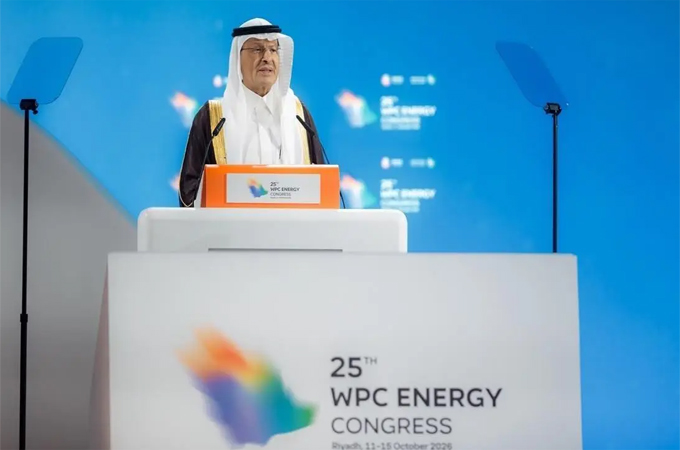
HRH Prince Abdulaziz bin Salman joins global energy ministers and industry leaders in Riyadh to address market stability, sustained investment and the future of energy.
Riyadh, Saudi Arabia – Saudi Arabia officially inaugurated the 25th WPC Energy Congress today, bringing together energy ministers, policymakers and industry leaders from around the world to address global energy security, market resilience and the investment required to meet future energy demand.
His Royal Highness Prince Abdulaziz bin Salman bin Abdulaziz Al Saud, Saudi Arabia’s Minister of Energy and Minister of Industry and Mineral Resources, and Pedro Miras, President of WPC Energy, inaugurated the Congress and exhibition at the Riyadh Front Exhibition and Conference Center, marking the first time the Kingdom has hosted the event in its 93-year history.
Held from 11 to 15 October under the theme “Pathways to an Energy Future for All,” the Congress provides a platform for international dialogue on energy security, investment, technological innovation and economic transformation.
Speaking during a high-level ministerial dialogue on global oil and gas markets, HRH Prince Abdulaziz bin Salman underscored the importance of strengthening energy resilience and maintaining flexibility in responding to market disruptions.
“The essence of how to attend to the crisis is that you have to focus on your resilience and creating options,” HRH Prince Abdulaziz bin Salman said.
Pedro Miras, President of WPC Energy, reinforced the importance of sustained investment in securing the global energy future.
“There can be no successful energy transition without energy security, and no lasting energy security without sufficient, sustained investment across the energy system,” he said.
Global Ministers Highlight Energy Security and Investment Priorities
The opening ministerial dialogue, “Future of Energy,” brought together senior government officials from the United States, Germany, Egypt, Türkiye and Mongolia to examine the challenges facing energy-producing and consuming economies.
Moderated by Daniel Yergin, Vice Chairman of S&P Global, the discussion focused on balancing energy security, affordability and sustainability while ensuring sufficient investment to meet growing demand.
Participating virtually, US Secretary of Energy Chris Wright emphasised the strategic importance of reliable energy supplies.
“Energy security is both economic security and national security,” Wright said.
Germany’s Federal Minister for Economic Affairs and Energy, Katherina Reiche, highlighted the challenge of balancing affordability, security of supply and sustainability.
Egypt’s Minister of Petroleum and Mineral Resources, Karim Badawi, called for greater international cooperation to mobilise upstream investment, while Türkiye’s Minister of Energy and Natural Resources, Alparslan Bayraktar, underscored the close relationship between energy market stability and global economic performance.
A second ministerial dialogue, “Perspectives on Global Oil and Gas Markets,” brought together HRH Prince Abdulaziz bin Salman; Alexander Novak, Deputy Prime Minister of Russia; Mohamed Arkab, Algeria’s Minister of State and Minister of Hydrocarbons; Heineken Lokpobiri, Nigeria’s Minister of State for Petroleum Resources; and Haitham Al Ghais, Secretary General of OPEC.
Discussions centred on global market resilience, supply security and the importance of sustained investment across the oil and gas sector.
“Energy security starts with investment, and if there is no investment, then there would be a problem,” Arkab said.
Al Ghais highlighted Saudi Arabia’s contribution to global energy security, describing the Kingdom as an example of providing an “insurance policy for energy security.”
Aramco CEO Calls for Long-Term Investment in Energy Resilience
Delivering the opening keynote, Amin Nasser, President and CEO of Aramco, emphasised that resilient energy systems must be developed well before market disruptions occur.
“Resilience that is designed, engineered, and built long before a crisis is therefore crucial,” Nasser said.
He highlighted Aramco’s investments in infrastructure, spare production capacity, alternative export routes, cybersecurity and operational flexibility as essential components of long-term supply security.
Nasser also said Aramco was studying additional crude oil export routes and expanding overseas storage capabilities in coordination with the Ministry of Energy.
“This crisis reinforces the need for practical, resilient pathways,” he added.
He further highlighted Aramco’s plans to increase sales-gas production capacity by approximately 80% by 2030 compared with 2021 production levels, alongside Saudi Arabia’s continued development of renewable energy.
The Congress’s first industry plenary brought together senior executives from Kuwait Petroleum Corporation, Baker Hughes and Weatherford to examine the role of oil and gas in supporting energy security, economic stability and long-term investment.
Vision 2030 Highlights Saudi Arabia’s Economic Transformation
The Saudi Ministerial Dialogue, “Vision 2030: Economic Transformation and Global Competitiveness,” examined the Kingdom’s progress in economic diversification, investment and fiscal sustainability.
The discussion featured Faisal Alibrahim, Minister of Economy and Planning; Fahad Al Saif, Minister of Investment; and Abdulmuhsen Alkhalaf, Vice Minister of Finance.
Addressing the relationship between economic growth and fiscal sustainability, Al Saif said: “I don’t see the two as conflicting. I see them reinforcing each other: growth, transformation and fiscal sustainability.”
He added that continued investment had expanded the Kingdom’s economy and revenue base, supporting its long-term fiscal objectives.
Global Energy Dialogue Continues in Riyadh
The Congress programme continues with discussions on the energy trilemma, digital technologies, financing the energy future and the importance of resilient energy systems.
Bringing together governments, energy companies, investors and technology leaders, the 25th WPC Energy Congress will continue through 15 October, advancing international cooperation and practical solutions to strengthen global energy security.
For programme updates, visit www.wpcenergy2026.org
About the 25th WPC Energy Congress
The 25th WPC Energy Congress is the flagship event of WPC Energy, bringing together governments, international energy companies, industry leaders, investors and experts from across the global energy value chain.
Established in 1933, WPC Energy provides an inclusive platform for international energy dialogue, partnership and knowledge exchange. Through its network spanning more than 60 member countries, WPC Energy promotes practical solutions for a secure, just and sustainable energy future.