



Uganda’s ambition to connect electricity to underserved communities is being challenged by a Shs570 billion financial burden inherited when the Rural Electrification Agency (REA) was absorbed into the Ministry of Energy and Mineral Development.
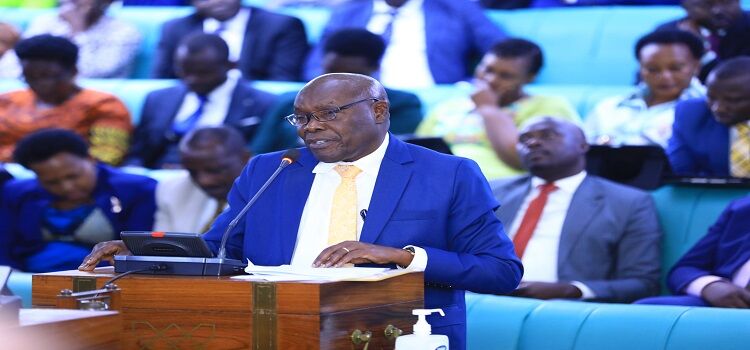
The State Minister for Energy, Hon. Sidronious Okaasai, said the ministry inherited obligations tied to contracts that were still under implementation when REA was mainstreamed, and that in the four years that followed, it received only about Shs222.078 billion, less than half of the inherited burden.
Hon. Okaasai said this while presenting a status report on the rural electrification programme to Parliament on Thursday, 13 August, 2026.
Deputy Speaker Thomas Tayebwa presided over the sitting.
“Due to inadequate budget coupled with delayed releases, the Ministry is constrained to maintain contractors working continuously on government-funded projects,” Hon. Okaasai said.
He added that the ministry requires an annual Shs200 billion to address inherited obligations while funding new rural electrification investments. He said that they had engaged the Ministry of Finance, Planning and Economic Development to raise the programme’s allocation to Shs161 billion in the 2026/2027 financial year, from Shs35 billion in 2025/2026.
Debating the statement, legislators highlighted various electricity supply challenges in their constituents.
Tororo South County MP Hon. Fredrick Angura (NRM) called for timely counterpart funding for the Uganda Electricity Distribution Company Limited and warned that delayed implementation increases borrowing and interest costs.
“Power must reach as many villages as possible, not only to improve livelihoods, but also to expand the economic base from which the country can repay its debts,” he said.
Hon. Christopher Bakashaba (NRM, Mbarara North Division) questioned how government could electrify rural Uganda while some newly created cities remain poorly connected.
Hon. Patrick Nsamba (NUP, Kassanda North) described the closure of REA as a miscalculation, while Hon. Charles Tebandeke (NUP, Bbaale) pointed to villages in Kayunga where poles had been installed but wires had not arrived.
Hon. Lydia Mirembe (NRM, Butambala District Woman representative) said her district had gone seven years without reliable electricity and that poles had been delivered without wiring.
In Arua Central Division, Hon. Muzaid Khemis (FDC) said national grid connectivity stood at about 25 percent while Arua was at roughly 6 percent. He also raised concerns about high tariffs in West Nile and the gap between national industrialisation goals and the cost of electricity outside the main grid.
Hon. Evelyne Ninsiima (Ind., Rubanda District Woman representative) framed the issue against Uganda’s long-term economic ambitions.
“A high-income economy cannot be built on unreliable electricity,” she said.
Under the Uganda Rural Electrification Access Project, 1,780.59 kilometres of medium-voltage lines and 2,646.53 kilometres of low-voltage networks were constructed. The project also installed 981 distribution transformers and connected 141,400 new consumers.
About half of the Project Affected Persons under the project reportedly remain unpaid, requiring an estimated Shs28.5 billion in compensation.
The report further revealed that the Accelerated Rural Electrification Programme, known as the Sub-County Project delivered 3,202.46 kilometres of medium-voltage lines, 6,827.82 kilometres of low-voltage lines and 180,000 connections. Yet it closed on April 3, 2024 without compensating any of the affected landowners, leaving an estimated Shs38 billion in claims.
The same tension emerged in the Energy for Rural Transformation Phase III project, financed by a US$135 million World Bank loan. The project closed with 14 of 21 planned line extensions incomplete and a reported outstanding government obligation of Shs5.5 billion.
The US$608 million Electricity Access Scale-Up Project, financed by the World Bank, targets households, refugee and host communities, industrial parks, businesses and public institutions.
The Ministry reports that, by June 2026, the project had delivered more than 235,906 one-pole and no-pole connections, 420,000 off-grid solar systems and 3,981 productive-use solar systems.
Deputy Speaker Tayebwa said Parliament would continue debating the performance of service-delivery ministries, including Energy, Health, Education and Works, into the following week.
Distributed by APO Group on behalf of State House Uganda.