

Natran Sees Growth Opportunities on CO2 Project in French Territory

By Ndubuisi Micheal Obineme
…set to launch a feasibility study on CO2 project development in France.
NaTran, the national gas transmission operator, sees growth opportunities in CO2 project development in France, following the conclusion of the company’s expressions of interest (EOI) carried out in the Hauts-de-France, Grand Est, Normandy, and Île-de-France regions.
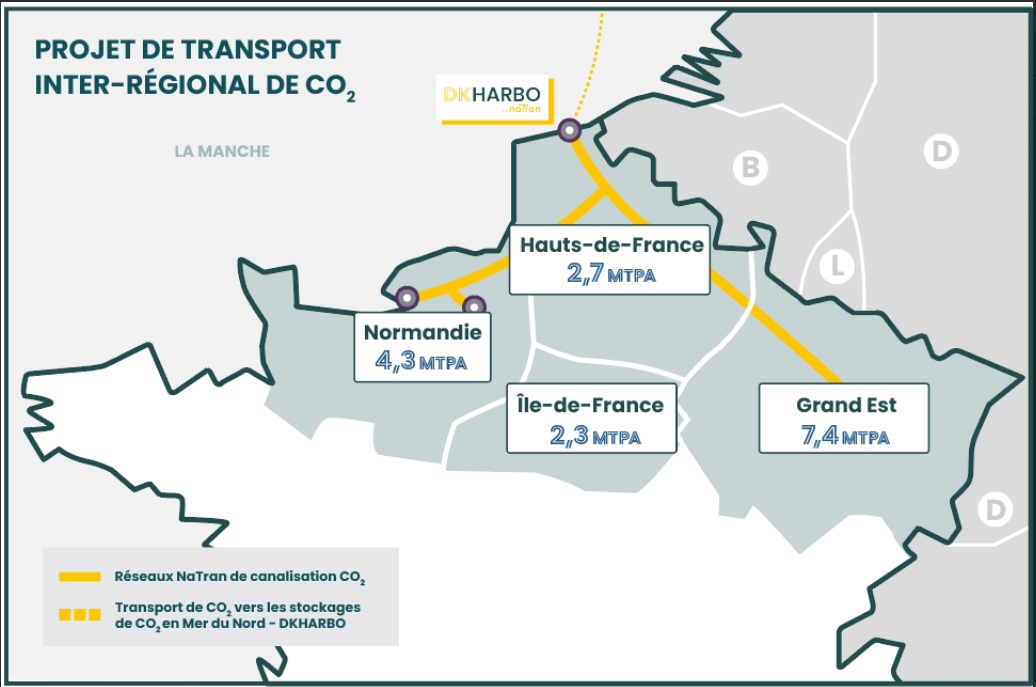
In a statement made known to The Energy Republic, Natran said it identified a total volume of 16.7 million tons of CO2, representing 27% of emissions from French manufacturing, that can be captured, transported for utilization, or permanently stored. The results confirm the need for a large-scale infrastructure project to support decarbonization and enhance the attractiveness of these regions.
According to Natran, it collected over 200 responses from stakeholders covering the entire CO2 value chain in the Hauts-de-France, Grand Est, Normandy, and Île-de-France regions. It covers:
- Nearly 90 industrial companies (industrial sites, waste managers, operators of biomass boilers or incinerators, etc.);
- More than 100 methanization sites wishing to valorize their biogenic CO2;
- 5 volume aggregators which, by pooling injection points, make it possible to integrate small emitters and optimize CO2 transport on a territorial scale;
- A sovereign storage project in the Paris Basin.
Furthermore, the Natran’s EOI reinforces the emergence of a French CO2 market, highlighting the growth opportunities in carbon capture and utilization projects.
The company also revealed that the EOI made it possible to identify CO2 outlet projects, via maritime terminals or pipelines at sea, towards final storage sites in geological formations as well as CO2 valorization sites (for the production of e-fuel in particular), contributing to the circular carbon sector in France.
The total identified transport requirement amounts to 16.7 million tonnes of CO2 per year, equivalent to 27% of emissions from the French manufacturing industry and 4.5% of French CO2 emissions.
These results confirm a significant availability of biogenic CO2, amounting to 6.4 million tonnes per year out of a total of 16.7 million tonnes. Substantial needs for projects utilizing this CO2 have also been identified by Natran, reaching 2 million tonnes per year.
The largest volumes were recorded in the Grand Est and Normandy regions. Issuers from Luxembourg, Germany, and Switzerland also expressed interest in NaTran, giving the project a cross-border dimension.
Based on these results, NaTran says it will launch a feasibility study in conjunction with interested parties and public decarbonization initiatives. It will be dedicated to the decarbonization of the northern part of France.
The project led by NaTran involves a CO2 transport backbone spanning approximately 1,000 kilometers across four French regions (Grand Est, Hauts-de-France, Normandy, and Île-de-France), connecting carbon capture and utilization projects, particularly in major industrial areas such as the Seine Valley and the Port of Dunkirk.
Operating within the framework of CCUS (Carbon Capture, Utilization, and Storage) technology, the project aims to transport captured CO2 emissions to sites for utilization or storage, notably through an interconnection with the Dunkirk-based DKHARBO project. Developed by NaTran in partnership with the Norwegian energy company Equinor, DKHARBO is designed to link the Port of Dunkirk to permanent geological storage sites in the North Sea. This connection with Dunkirk and the DKHARBO project, a CO2 export hub, thus secures large-scale transport capacities.
“The project led by NaTran addresses a real need for economic actors and territories committed to decarbonization and the development of the new e-fuel sector. Already convinced of the relevance of CCUS technology, this call for expressions of interest reinforces our commitment to the sector to develop this innovative solution in service of the energy transition and industrial sovereignty, ” declares Anthony Mazzenga, Director of Development at NaTran.
The inter-regional CO2 transport project, led by NaTran across a large area of northeastern France, is fully aligned with the NaTran2030 corporate project, which includes the development of 1,000 kilometers of hydrogen and CO2 networks by 2030. Beyond this inter-regional transport project and the DKHARBO project, NaTran is deploying a CO2 transport project in western France, called GOCO2. These projects represent the first step in the gradual deployment of a national CO2 transport network.